
Friction brake technical guide
Measure the friction system and find the cause of wear, noise, vibration, or drag before replacing parts
Pads, rotors, calipers, shoes, drums, hoses, hubs, bearings, tires, suspension, hydraulic pressure, parking-brake mechanisms, and electronic service modes interact. A noise, pulsation, hot wheel, thin pad, or worn rotor can be real without identifying why it happened or which complete repair scope will keep the condition from returning.
Stop for a major braking change, smoke, fluid loss, or severe overheating
Stop safely and arrange recovery when the pedal sinks, becomes unexpectedly hard or very soft, braking force drops, the vehicle pulls severely, a red warning remains on, fluid is actively leaking, grinding accompanies reduced braking, or smoke and intense heat come from a wheel. Do not touch a hot wheel or apply water to a severely overheated brake, and do not continue driving to “clean up” a grinding noise.
Record warning lamps, pedal feel, sound, vibration location, direction of pull, speed, temperature, recent brake or tire work, parking-brake use, towing or downhill events, and which wheel appears hot. An amber ABS warning, friction wear message, parking-brake fault, and red hydraulic warning describe different detected conditions; use the owner’s manual and complete inspection rather than one generic response.
Pad thickness alone does not define the complete repair
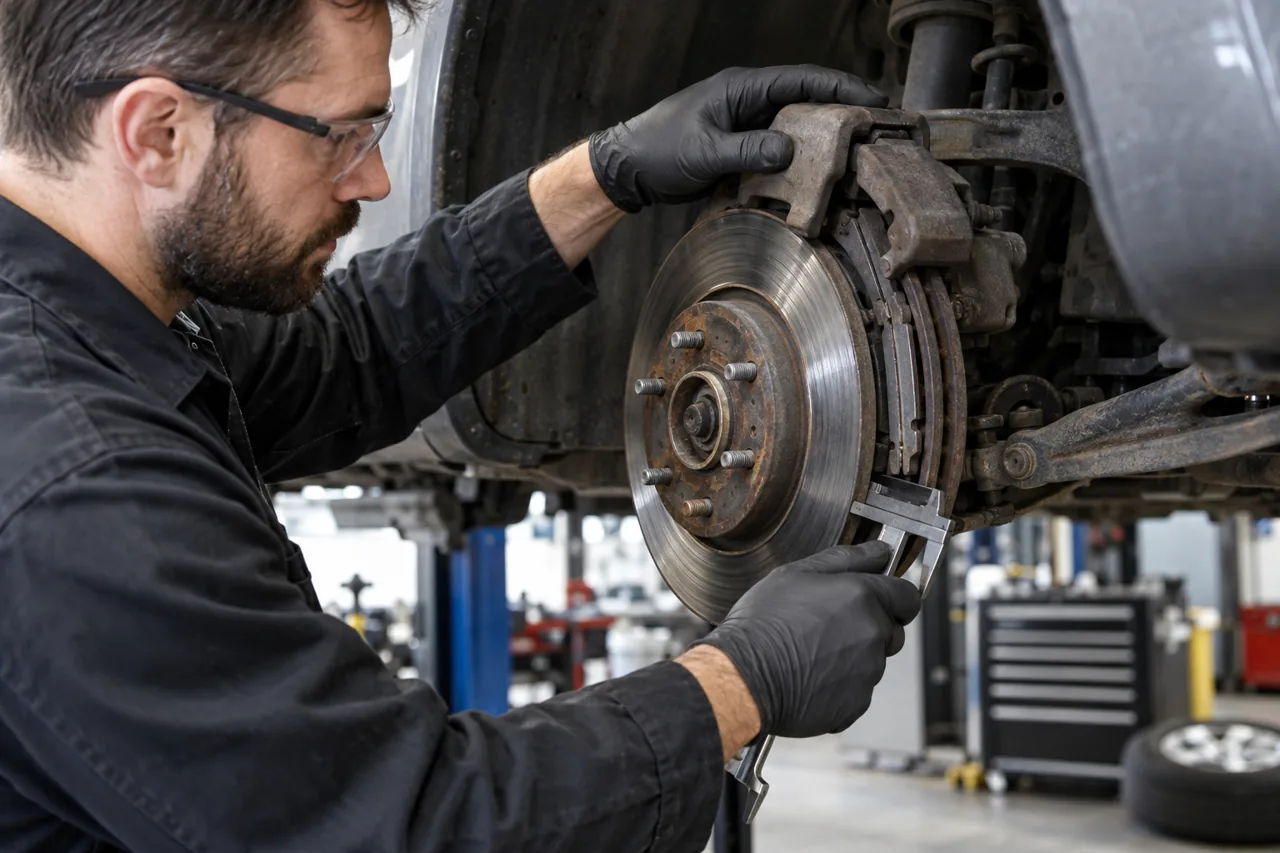
Measure inner and outer pad or shoe friction material at each relevant wheel and compare patterns across the axle. Unequal inner-to-outer, leading-to-trailing, diagonal, or side-to-side wear can indicate stiff slides, piston trouble, pad binding, incorrect hardware, hose restriction, parking-brake faults, rotor or drum geometry, contamination, or installation problems. Preserve the pattern before discarding parts.
Confirm the manufacturer wear limit and sensor design rather than estimating through a wheel opening. A warning sensor may be single-use, modelled by mileage, installed at only one corner, or absent. Cracking, separation, glazing, crumbling, taper, heat damage, oil or fluid contamination, and backing-plate corrosion can justify action even when remaining thickness appears adequate.
Rotor thickness, variation, runout, surface, and hub condition answer different questions
Measure rotor thickness with a suitable micrometer at multiple circumferential positions away from the wear ridge and compare the lowest value with the marked or published minimum. Thickness variation can contribute to torque variation and pedal or steering pulsation. Lateral runout is measured separately with the rotor secured to a clean hub; bearing play, hub runout, corrosion, wheel mounting, and uneven fastener torque can influence the result.
HELLA emphasizes cleaning and measuring the hub as well as the disc because replacing a rotor on a damaged or contaminated mounting face can reproduce runout. Inspect scoring, cracking, heat spots, rust, pitting, transfer layers, edge condition, and friction-face contamination. Machining or reuse is acceptable only when the final dimensions, finish, structure, and manufacturer procedure support it.
Noise and vibration can originate outside the friction pair
Squeal, scrape, click, clunk, grinding, pedal pulsation, steering shake, or body vibration should be tied to braking force, speed, temperature, direction, road surface, and whether the sound occurs with or without pedal application. Pads and rotors can produce noise, but shields, wheel bearings, hubs, tires, suspension joints, axle hardware, loose components, corrosion, and drivetrain parts can imitate it.
Do not replace rotors solely because the steering shakes or call every pulsation a “warped rotor.” Inspect tire and wheel condition, bearing play, hub cleanliness and runout, suspension and steering joints, fastener torque, and measured disc variation. A successful diagnosis explains why braking changes the symptom and which measured condition supports the repair.
Caliper drag requires piston, slide, pad fit, hose, and hydraulic checks
A hot wheel, pull, odor, premature wear, poor economy, or slow wheel rotation can involve a sticking piston, corroded slide, swollen or restricted hose, pad seized in its support, parking-brake mechanism, residual hydraulic pressure, master or control fault, wheel bearing, or incorrect installation. Compare temperatures and release behavior cautiously; heat alone does not name the failed component.
Inspect piston boot and leakage, guide boots and movement, bracket contact surfaces, pad fit, hose damage or twist, bleeder behavior, parking mechanism, and whether opening the hydraulic path changes drag under a controlled procedure. HELLA advises checking caliper piston sealing and smooth movement, slides, hoses, hub, bearing, and suspension together. Replace or rebuild only when the service information and condition permit.
Drum brakes add shoe orientation, springs, adjusters, wheel cylinders, and drum diameter
Record drum position and hardware layout before disassembly because primary and secondary shoes, springs, levers, struts, adjusters, clips, and parking-brake parts may differ by side and direction. Inspect lining thickness and bonding, glazing, cracking, contamination, wheel-cylinder leakage, backing-plate pads, spring condition, adjuster freedom and orientation, cable return, and heat evidence.
Measure drum inside diameter, taper, out-of-round, surface, cracks, and maximum diameter using the exact specification. A new shoe cannot correct an oversized or distorted drum, leaking cylinder, seized adjuster, weak hardware, or parking cable. After service, perform the specified basic adjustment; HELLA notes that parking-brake adjustment is required after shoe, integrated caliper, adjuster, or cable work.
Replacement scope includes hardware, hoses, fluid control, and electronic modes
Define pads or shoes, rotors or drums, calipers or wheel cylinders, brackets, slides, springs and clips, wear sensors, hoses, seals, fasteners, wheel bearings or hubs, parking-brake components, fluid and bleeding, and any axle-pair policy. HELLA states that brake discs should be replaced in axle pairs and that pads require a rotor still above its minimum thickness.
Electronic parking brakes, electro-hydraulic systems, brake-by-wire, regenerative blending, and service indicators can require scan-tool modes, power support, disable/enable sequences, adaptations, or resets. Do not force a piston or energize a system using a generic method. Support removed calipers rather than hanging them from hoses, control reservoir level while retracting pistons, and use only specified lubricants at specified contact points.
Clean installation and wheel fastening affect the result
Clean the hub face, bracket contacts, guide components, and new rotor friction surfaces without damaging them. Confirm the rotor sits flush, pads move as designed, boots and clips are seated, hoses are not twisted, bleeders face correctly, fasteners receive the exact preparation and torque, and the wheel contact face is clean. Incorrect solid-containing lubricant or contamination on friction surfaces can create noise or braking loss.
Wheel fastener sequence and torque influence clamping and future service; use calibrated tools and the vehicle procedure. Pump or initialize the brake pedal before vehicle movement, establish fluid level, activate and adjust parking-brake functions as specified, check for leaks, and verify free rotation or intended light contact before road testing.
Bedding and verification must reproduce the original complaint safely
New pads, shoes, rotors, or drums may require a manufacturer-defined bedding process to establish compatible contact and transfer without overheating. Do not improvise repeated emergency stops on public roads or hold a hot friction pair clamped after aggressive braking. Explain temporary feel, odor, or performance limits only when supported by the product and vehicle instructions.
Complete a controlled low-speed check, brake test where available, and road test for pedal, pull, noise, vibration, temperature balance, parking brake, warning lamps, ABS or stability status, and the original condition. Reinspect leaks, fluid level, wheel fasteners when required, and disturbed components. A complete result documents measurements before and after, parts and hardware used, bedding performed, and any remaining monitoring.