
Climate-control technical guide
A recharge restores a specified refrigerant mass; it does not explain why cooling was lost
Weak or intermittent air conditioning can involve refrigerant quantity or contamination, leakage, airflow, temperature and pressure sensing, fans, valves, compressor command or internal condition, electrical supply, software, or thermal-management strategy. A compressor noise or low charge is evidence within the system—not automatic proof that one component or a can of refrigerant is the complete repair.
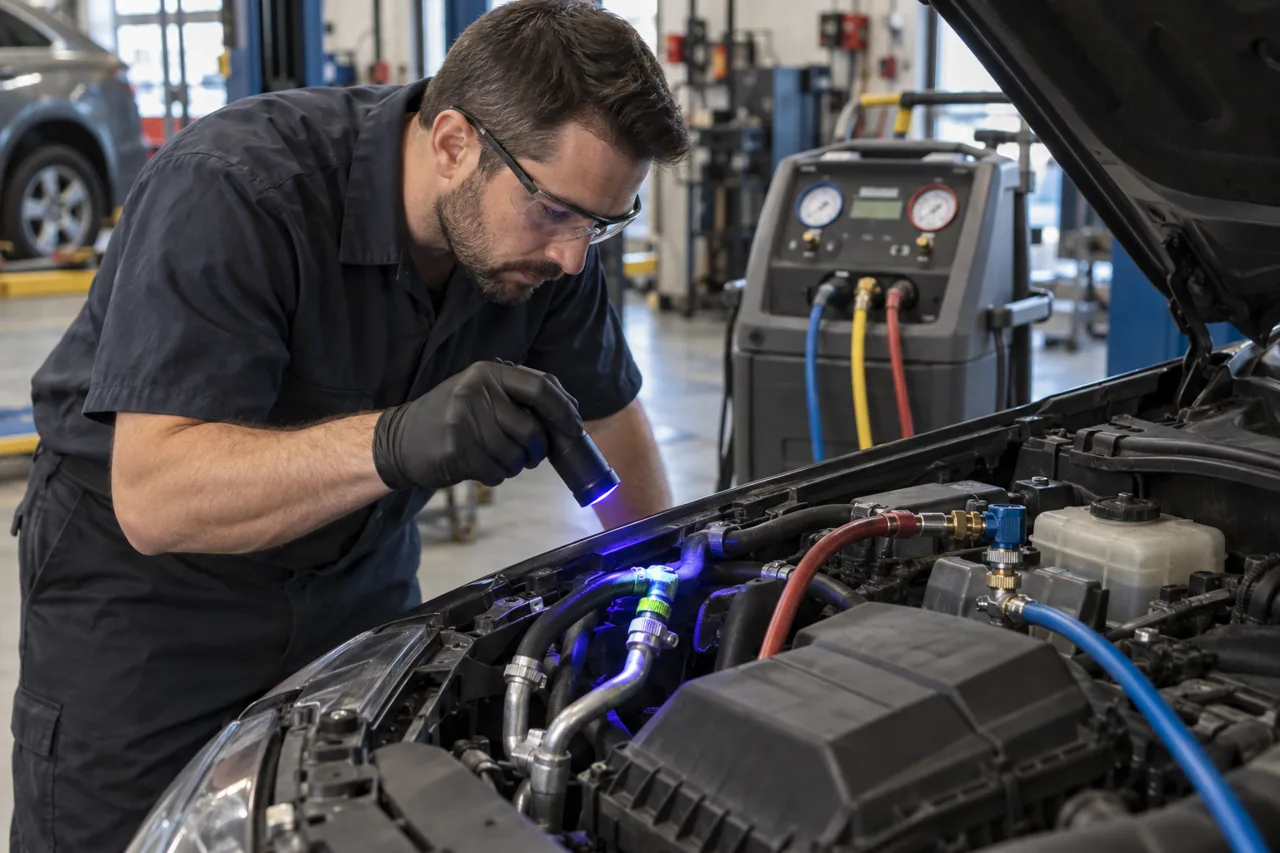
Identify the refrigerant and vehicle configuration before connecting equipment
Use the under-hood label and exact vehicle information to identify refrigerant type, specified charge mass, lubricant requirement, service fittings, and special instructions. R-134a, R-1234yf, R-744, older refrigerants, and retrofit configurations are not interchangeable. EPA requires unique fittings for approved refrigerants and says adapters should not be used to convert one refrigerant fitting to another.
Hybrids and electric vehicles may use a high-voltage electric compressor and a lubricant chosen for electrical insulation; incompatible oil, contaminated equipment, or an incorrect procedure can create component damage or shock risk. Some systems cool the traction battery or power electronics as well as the cabin. Confirm service capability, equipment segregation, technician qualification, and the exact thermal architecture before opening the circuit.
Refrigerant must be recovered—not released—and paid service requires qualified handling
EPA states that intentional refrigerant venting is prohibited and that people servicing motor-vehicle air conditioning for payment must hold Section 609 certification and use approved handling equipment. Recovered refrigerant must be recycled or reclaimed before reuse, even when it returns to the same vehicle. A website tutorial or inexpensive charging hose does not replace those requirements.
The work order should identify the refrigerant, equipment process, recovered amount when available, added amount, oil or dye added, and contamination concerns. Stop if the refrigerant identity is uncertain or an identifier indicates mixture. Cross-contaminated refrigerant can damage service equipment and other vehicles; it needs an appropriate containment and disposition plan rather than being diluted with fresh product.
Describe the cooling complaint under specific operating conditions
Record ambient temperature and humidity, sun load, engine or READY state, idle versus road speed, selected mode, fan speed, vent location, recirculation, left-right difference, stop-and-go behavior, recent work, and whether the system begins cold then warms. Note noises, odors, visible frost, water entry, warning messages, overheating, or charging and battery-temperature effects on an electrified vehicle.
Weak airflow is different from warm air at normal flow. A plugged cabin filter, blower, door actuator, evaporator icing, case restriction, or duct problem may not be corrected by refrigerant service. Cooling that fails only at idle can point toward airflow or fan control; a temperature difference between sides can involve charge distribution or air doors. Establish the symptom before connecting gauges.
Inspect and scan the whole system before judging pressure
Inspect belt or electric-compressor configuration, condenser and radiator airflow, fans, debris and impact damage, hoses, crimps, ports, caps, fittings, compressor, clutch where fitted, wiring, grounds, fuses, relays, drainage, and visible oil residue. Scan climate, engine, body, hybrid, battery, and network modules as applicable; preserve codes and temperature, pressure, command, fan, door, and compressor data.
Static or running pressure is influenced by ambient conditions, refrigerant mass, airflow, compressor displacement or command, valves, heat load, and where the sensors measure. One gauge number cannot identify a compressor. Compare pressure and temperature relationships under a defined test condition using model procedures, and distinguish a sensor value from a trusted independent measurement when plausibility is in question.
A low charge requires leak evidence and an appropriate repair plan
A sealed system does not consume refrigerant like fuel. If recovered mass is below specification, determine whether there is an active leak, a prior incomplete service, a known small loss over a long period, or uncertain history. Inspect accessible joints and components using approved electronic, ultraviolet, pressure, vacuum, or trace-gas methods as applicable; each method has limitations and safety requirements.
Oil staining or dye can guide inspection but does not prove the current leak rate. Vacuum retention is useful for process control yet may not reproduce a pressure-side or heat-related leak. Do not add sealants or unapproved substances that can restrict components or contaminate equipment. Define whether the next step is repair now, monitored operation, or further access testing, and explain why.
Recharge by recovered evidence, evacuation process, and exact mass
A proper recharge recovers the existing refrigerant, evaluates what came out, evacuates according to the system and equipment procedure, checks process stability, and installs the specified refrigerant mass. Charging by can pressure, sight glass, vent temperature alone, or a generic “full” reading can leave the system undercharged or overcharged. Both can reduce cooling and stress components.
Evacuation helps remove air and moisture under controlled conditions but is not proof that every leak is absent. Add only the oil quantity and type supported by the repair and recovered evidence; the compressor does not automatically need the full system oil capacity. Record exact amounts and any limitations, then evaluate pressures, temperatures, airflow, command, and cycling after the known charge is established.
Compressor diagnosis must include command, load, lubrication, and the rest of the circuit
A belt-driven compressor may use a clutch or variable control valve; an electric compressor uses high-voltage power electronics and control. No engagement or displacement can involve pressure limits, sensors, ambient or evaporator temperature, engine cooling, fan faults, low voltage, wiring, relay, clutch gap, control valve, module command, software, refrigerant state, or an internal compressor fault.
Noise can originate from a pulley, bearing, belt drive, tensioner, clutch, refrigerant pulsation, lines, mount, fan, or internal compressor damage. DENSO recommends systematic diagnosis rather than assuming the compressor. Confirm command and response, check the operating envelope, and investigate oil quantity, contamination, overheating, restriction, or liquid return that could damage a replacement.
Internal failure changes the replacement and contamination scope
When a compressor fails internally, debris and degraded oil can move through the condenser, hoses, valves, receiver-drier or accumulator, and evaporator. Some modern condensers and mufflers cannot be reliably flushed. MAHLE guidance emphasizes vehicle-specific flushing, oil quantity and viscosity, and replacement of components that cannot be cleaned. The exact scope depends on failure evidence and component construction.
An estimate should state whether it includes the compressor, clutch or control valve, condenser, expansion device or orifice, receiver-drier or accumulator, seals, hoses, cleaning or flushing, oil, refrigerant, one-time hardware, and contamination disposal. Replacing only the compressor without correcting restriction, fan failure, wrong oil, debris, or system control can cause repeat failure.
Verify cabin performance and system protection after repair
After service, inspect ports and caps, every disturbed joint, routing, belt or cable clearance, fan operation, condensate drainage, and leaks. Confirm expected compressor command and response, high- and low-side behavior, vent and inlet temperatures, airflow and mode doors, cycling or variable displacement, engine cooling, and any battery or power-electronics thermal function under a defined ambient condition.
Repeat the original idle, traffic, cruise, heat-soak, restart, side-to-side, charging, or high-load concern. Re-scan related modules and confirm no new pressure, temperature, isolation, fan, compressor, or communication fault. A successful result documents the charge and repair evidence, demonstrates stable cooling without abnormal noise or pressure, and defines any leak recheck or future monitoring.