
2026 U.S. repair cost detail
A/C diagnosis or basic service: price, process, and questions
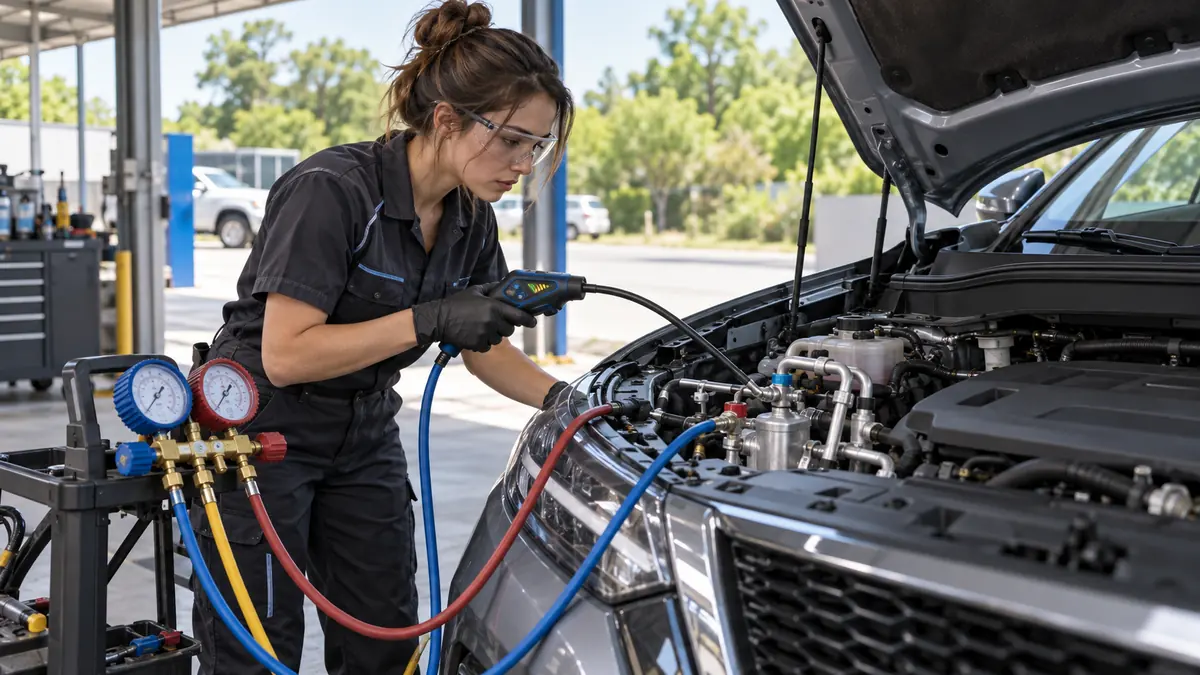
A/C cost depends on whether the task is performance diagnosis, leak detection, refrigerant recovery and recharge, electrical testing, or repair. Adding refrigerant without understanding why cooling was lost can hide the actual scope.
Choose the next step
Check the assumptions behind this estimate
Compare other repairs, confirm the evidence, account for the vehicle, and prepare the right questions before authorization.
Cost anatomy
What the price can be made of
A useful estimate separates the major scope instead of presenting one unexplained total. Not every line below applies to every vehicle.
Performance diagnosis
Vent temperature, ambient conditions, pressures, airflow, fan operation, commands, and fault data establish the problem.
Refrigerant handling
Recovery, vacuum, measured recharge, refrigerant type, and quantity require appropriate equipment.
Leak or electrical testing
Dye, electronic detection, nitrogen where appropriate, circuit checks, and command testing may be separate.
Verification
Stable vent temperature, pressure behavior, fan/airflow, leak observations, and control operation should be rechecked.
Repair method
A defensible service process
The exact factory procedure changes by VIN and equipment, but the estimate should still make these decision stages visible.
- 01
Confirm the complaint, ambient conditions, airflow, temperature controls, fans, and stored faults.
- 02
Identify refrigerant type and charge specification before connecting compatible equipment.
- 03
Measure system behavior and test supported causes such as low charge, airflow restriction, sensor/control faults, or compressor command.
- 04
Perform only the authorized service or repair, then verify cooling and pressure behavior under useful conditions.
Price variables
What can move the total
- R-1234yf versus R-134a refrigerant and equipment
- Leak location and access
- Compressor, condenser, evaporator, valve, sensor, or electrical repair
- Hybrid/EV high-voltage compressor oil and safety procedure
Common questions
Questions drivers ask before authorization
Is refrigerant consumed normally?
A sealed system is not intended to consume refrigerant like fuel. Loss usually deserves a leakage assessment.
Can pressure alone identify the failed part?
No. Ambient temperature, airflow, charge, commands, and system design affect pressures.
Why is R-1234yf often more expensive?
Refrigerant, equipment, handling, and vehicle procedures differ from older R-134a systems.
Does weak airflow mean low refrigerant?
Not necessarily. Cabin filters, blower, doors, ducts, icing, or control faults can reduce airflow.
What should a completed service verify?
Ask for refrigerant quantity handled, leak findings, vent temperature/conditions, pressure behavior, and remaining limitations.
Estimate checklist
Ask the shop to identify
- The exact vehicle, system, concern, and evidence supporting the work.
- Diagnostic labor, repair labor, parts, fluids, hardware, programming, calibration, disposal, tax, and excluded work.
- Which assumptions could require additional authorization after inspection or disassembly.
- The parts category and written parts-and-labor warranty.
- How the original symptom or maintenance result will be verified.
Method, limitations, and sources
The range is an editorial budgeting band for Greater Seattle and Puget Sound independent-shop planning in 2026. It reflects broad variation in imported and European vehicles and is deliberately wider than a single-shop advertised price. It is not a market average, offer, or substitute for a VIN-specific written estimate.
Continue by decision
Useful next steps for this topic
Choose the path that matches what you need to decide next. These links are selected from the same vehicle system, symptom, service, or regional context.
Follow the diagnostic evidence
A recharge restores a specified refrigerant mass; it does not explain why cooling was lost
Weak or intermittent air conditioning can involve refrigerant quantity or contamination, leakage, airflow, temperature and pressure sensing, fans, valves, compressor command or in…Follow the diagnostic evidence
Engine and cabin air filters look similar but protect different systems and require different diagnosis
An engine air filter protects the intake path that supplies combustion; a cabin filter treats air entering the passenger compartment through the heating and air-conditioning case.…Understand the service scope
Seattle-area auto electrical repair starts with a loaded circuit test
A dead battery, slow crank, warning lamp, intermittent no-start, or repeated low-voltage fault in SeaTac or Seattle does not identify a single failed part. The battery, alternator…Follow the diagnostic evidence