
Climate system
SeaTac auto A/C repair starts with airflow, temperature, and leak evidence
When cooling fades in SeaTac or Seattle traffic, the first task is to separate weak airflow from weak refrigeration and control faults. Refrigerant charge, leakage, compressor operation, sensors, fans, electrical control, air doors, and heat entering the cabin can overlap; adding refrigerant without a baseline can hide the actual failure.
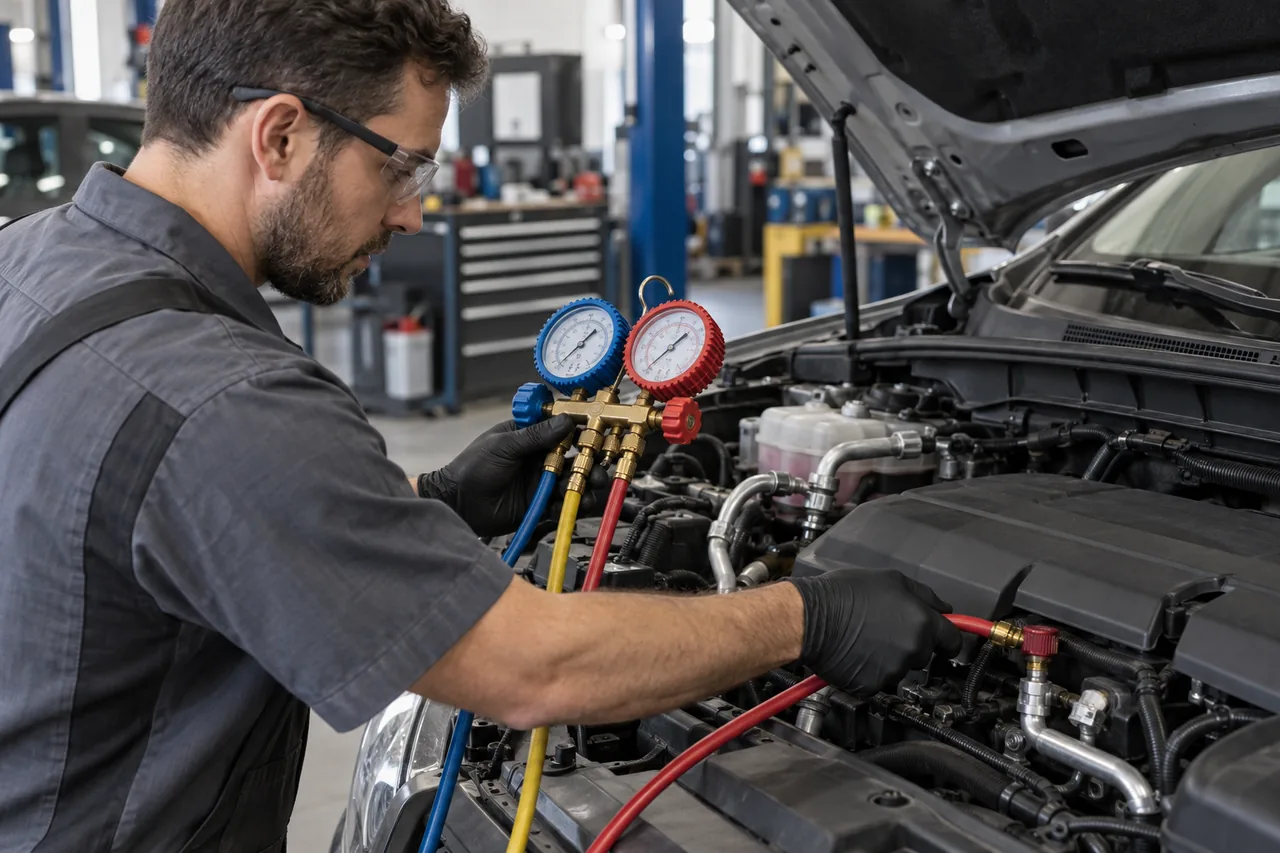
Quick decision: recharge, diagnose, or stop using the system
A recharge is justified only after the specified charge is known and the reason for low refrigerant is addressed. Strong airflow that is warm calls for temperature, refrigerant, compressor, fan, and control checks; weak airflow calls for filter, blower, evaporator, duct, or air-door inspection. Noise, smoke, a burning odor, damaged wiring, or belt distress calls for shutting the system off and arranging inspection.
SeaTac and Seattle traffic can expose weak condenser airflow because cooling may deteriorate at idle and improve at road speed. That pattern is useful evidence, not a final diagnosis: fan operation, condenser condition, charge, compressor command, ambient temperature, and pressure or scan data must be compared.
Describe what weak cooling actually does
Useful clues include cooling that fades at idle, air that starts cold and becomes warm, one side of the cabin differing from the other, a blower that changes speed, unusual compressor noise, or cooling that returns only after the vehicle is moving. Note outside temperature, humidity, drive time, selected mode, and whether the issue affects every vent.
Air volume and air temperature are different concerns. Weak airflow can involve a cabin filter, blower, evaporator restriction, or air-distribution door even when the refrigerant circuit is working. Strong airflow that is not cold points the investigation toward temperature control, refrigerant performance, compressor command, or heat entering the air stream.
Measure performance before adding refrigerant
A baseline check should record ambient temperature, vent temperature, blower setting, engine speed, and system pressure or other manufacturer-specified data under controlled conditions. A visual inspection also looks for damaged condensers, oily residue, belt concerns, connector damage, blocked airflow, and evidence of previous sealant or incorrect service.
Pressure readings are not interpreted in isolation. Charge amount, airflow across the condenser and evaporator, compressor type, valve operation, sensor input, and ambient conditions all change the expected result. Adding refrigerant until a gauge appears acceptable can overcharge the system and hide the original fault.
Why repeated recharging is not a repair
Refrigerant circulates in a closed system. If the charge is low, refrigerant has escaped or a previous service left the amount incorrect. The next task is to find credible leak evidence and determine whether the repair is practical, rather than scheduling periodic top-offs as though refrigerant were a consumable fluid.
Leak detection may use visual inspection, electronic equipment, ultraviolet dye that is already present or deliberately added, and vacuum or pressure procedures appropriate to the system. No single method finds every leak immediately. Very small or intermittent leaks may require cleaning the area, operating the system, and returning for a documented follow-up inspection.
Worked scenario: cold on the highway, warm in airport traffic
Consider a vehicle that cools on the highway but becomes warm while waiting in slow airport traffic. The change with vehicle speed supports checking condenser airflow, cooling-fan command and operation, debris or fin damage, compressor control, and system pressures under both conditions. It does not by itself prove that refrigerant is low or that the compressor has failed.
A defensible estimate records the baseline at idle and increased airflow, states which relationship failed, and separates a fan or control repair from any refrigerant recovery, leak repair, evacuation, and measured recharge. The result should then be verified in the same low-speed condition that produced the complaint.
Electrical and control faults can mimic a refrigerant problem
A compressor may not operate because the control system is protecting against an implausible pressure or temperature signal, because power or ground is missing, or because another engine or climate-control fault prevents the command. Variable-displacement compressors can also have poor output without the obvious on-and-off cycling associated with older designs.
Diagnosis can include command status, sensor comparison, voltage-drop testing, actuator operation, blower control, and communication between climate and engine modules. The goal is to determine whether the system is being commanded correctly and whether the mechanical result matches that command before condemning a compressor or control module.
The refrigerant specification matters
The under-hood label identifies the refrigerant type and specified charge for the particular vehicle. Refrigerants are not interchangeable, and the service equipment, fittings, oil, recovery procedure, and safety precautions must match the system. Hybrid and electric vehicles can introduce additional compressor-oil and high-voltage requirements.
A precise charge is normally installed by weight after the system has been properly recovered and evacuated according to the repair procedure. The correct quantity does not prove the system is healthy, but it provides a known starting point for performance testing and protects against conclusions based on an unknown charge.
Verify cooling, airflow, leaks, and controls
After repair, repeat the baseline conditions and compare vent temperature, pressure or scan data, compressor response, fan operation, and airflow. Confirm that mode and temperature doors respond throughout their range and that condensate drains correctly. A cold center vent alone does not confirm even cooling across zones or stable performance at idle.
The final explanation should identify the repaired fault, the evidence observed, refrigerant type and amount when the circuit was serviced, and whether a follow-up leak check is recommended. If cooling deteriorates again, record when it happens rather than repeatedly adding refrigerant, because the recurrence pattern is valuable diagnostic evidence.