
Electrified vehicle diagnosis
Identify the electrified architecture, safety state, and failed system before planning repair
Battery-electric vehicles, hybrids, and plug-in hybrids combine familiar chassis and low-voltage systems with model-specific high-voltage batteries, power electronics, electric machines, charging equipment, thermal management, controls, and safety interlocks. A warning, range change, charging problem, or no-READY condition does not identify a battery pack—or prove that a general repair facility is equipped and authorized for the required high-voltage work.
Treat collision, flood, heat, odor, smoke, noise, or battery damage as a special hazard
Move away and contact emergency services for smoke, flame, sparking, increasing heat, unusual popping or hissing, or irritating vapor from the battery area. Do not touch exposed orange cables or damaged electrical components, attempt to disconnect a traction battery, charge a damaged vehicle, or park a suspected damaged lithium-ion vehicle next to a building or other combustible property. Battery events can develop or recur after an impact appears over.
NHTSA says physical damage or flooding can create immediate or delayed shock, toxic or flammable gas, and fire hazards, and advises treating high-voltage components as energized. Recovery, towing, storage distance, monitoring, and manufacturer contact require an incident-specific plan. A normal-looking READY indicator or silent drivetrain does not establish that a damaged high-voltage system is safe.
Identify battery-electric, hybrid, plug-in hybrid, and system generation precisely
Record the VIN, model year, build configuration, propulsion type, battery chemistry and generation where service information distinguishes them, charging equipment, drivetrain, prior modifications, collision or flood history, repair campaigns, and exact warning messages. A battery-electric vehicle has no combustion engine, while a hybrid or plug-in hybrid retains engine, fuel, exhaust, lubrication, and emissions maintenance alongside its electric drive.
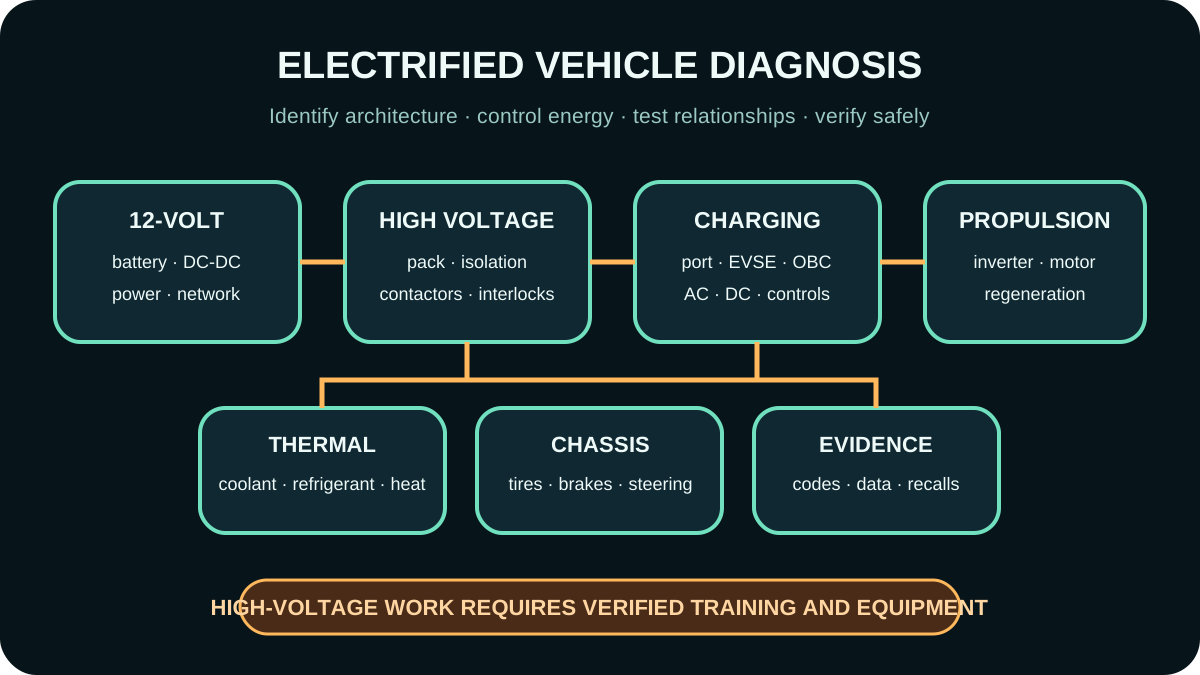
Components and energy paths can include a traction battery, contactors, service disconnect, battery-management system, inverter, motor-generators, DC-DC converter, onboard charger, charge port, high-voltage junctions, electric compressor or heater, coolant circuits, regenerative braking, 12-volt battery, and networked controllers. Similar model names can use different pack voltages, connectors, lifting points, disabling steps, and repair permissions.
A weak 12-volt system can prevent READY and generate widespread warnings
NHTSA distinguishes the traction battery from the 12-volt battery that powers instruments and control functions, often replenished through a DC-DC converter instead of a conventional alternator. Low 12-volt voltage, terminal resistance, ground faults, sleep-current problems, converter control, or a failing auxiliary battery can prevent contactors from closing, interrupt charging, or produce multiple communication and chassis warnings.
Begin ordinary low-voltage diagnosis with condition, voltage under relevant load, connections, voltage drop, converter output, sleep behavior, and complete module scans. Follow model instructions before boosting or disconnecting power; NHTSA notes that the high-voltage battery cannot be jump-started, while a 12-volt jump may be permitted according to the owner’s manual. Never attach conventional test equipment to orange or high-voltage circuits.
Preserve full-system codes and operating data before resets or power-down
Scan battery, charging, inverter, motor, thermal, brake, body, restraint, powertrain, gateway, and low-voltage modules as equipped. Save confirmed, pending, history, permanent, and communication faults; freeze frame; 12-volt supply; isolation information; cell or module values where exposed; temperatures; contactor command; charge state; power limits; thermal commands; charging data; and software or calibration identifiers before clearing or disconnecting anything.
A code naming isolation, battery, charger, motor, inverter, contactor, coolant valve, sensor, or communication identifies the monitored circuit or relationship. It does not establish which assembly needs replacement. Service campaigns, recalls, software updates, collision interlocks, charge-port damage, cooling faults, low voltage, connector problems, or another module can alter the same data. Record the sequence and reproduce only conditions known to be safe.
High-voltage isolation and disabling require trained people, exact procedures, and verified equipment
NHTSA states that qualified technicians need specialized EV high-voltage training, personal protection, and diagnostic equipment. Switching the ignition off, removing a 12-volt terminal, pulling an orange connector, or waiting a generic number of minutes is not proof of electrical isolation. Contactors, stored energy, capacitors, remote wake-up, charging equipment, damaged circuits, and model-specific shutdown logic must all be considered.
The work plan should identify technician qualification, restricted work area, vehicle-specific disabling and verification steps, rated meter and leads, inspected insulating protection, insulated tools, lockout and tagging, keys and remote transmitters, lifting and battery support equipment, and what happens if isolation cannot be verified. This educational page does not authorize high-voltage work or claim that the current operator has these capabilities; availability must be confirmed directly.
Separate vehicle charging faults from the cable, EVSE, site power, and account
Record whether the concern affects AC charging, DC fast charging, one location or every location, scheduled charging, a particular state of charge, temperature, connector position, or a recent software change. Capture charger messages, vehicle warnings, charge-port condition, pilot or proximity status where supported, onboard-charger data, battery temperature and limits, and the EVSE or station error without defeating interlocks.
A failed session can involve building supply, breaker or receptacle condition, grounding, an EVSE cable or connector, public-network authorization, charge scheduling, port locks, contamination, damaged pins, communication, onboard charger, DC inlet path, battery temperature, pack state, or software. Do not use adapters, extension cords, overheated receptacles, or repeated resets as diagnosis. Licensed electrical work and vehicle high-voltage work are separate scopes.
Range and battery-health concerns need normalized evidence, not one dashboard estimate
Displayed range changes with temperature, speed, elevation, wind, HVAC use, payload, tire pressure, route, driving history, accessory loads, battery temperature, state of charge, and software estimation. Compare energy use over repeatable conditions and distinguish reduced predicted range from reduced usable energy, restricted power, slow charging, imbalance, thermal limitation, or an actual battery fault.
Battery evaluation may review usable energy, state-of-health metrics where manufacturer-supported, cell or module balance, temperature spread, isolation, charge and discharge limits, fault history, cooling operation, and warranty or campaign criteria. Generic scan values and third-party percentages are not automatically equivalent to the manufacturer’s capacity test. Define the test method and uncertainty before recommending module or pack replacement.
Thermal management links the cabin, battery, power electronics, and charging
Electric vehicles may use shared or interacting refrigerant and coolant circuits for cabin comfort, battery conditioning, motors, inverter, charger, and heat-pump operation. A range or charging complaint can therefore involve coolant level and concentration, pumps, valves, sensors, radiators, chillers, heaters, refrigerant charge, electric compressor oil compatibility, airflow, software, or component isolation—not only the traction battery.
Identify every affected loop and use approved fluids, filling equipment, vacuum or bleeding steps, refrigerant service equipment, and electrical-safety procedures. Cross-contamination or an incorrect compressor oil can create electrical risk or component damage on some systems. After repair, verify temperatures and commanded flow under charging, cabin, driving, and ambient conditions relevant to the original concern.
Tires, brakes, steering, suspension, bearings, and cooling still need disciplined maintenance
The Department of Energy notes that all-electric vehicles generally have fewer moving parts and fluids, while hybrids and plug-in hybrids retain conventional-engine maintenance. Fewer engine services do not mean no maintenance. Vehicle mass, immediate torque, alignment, tire specification and pressure, wheel damage, suspension, bearings, wipers, cabin filters, coolant, brake fluid, and corrosion remain relevant.
Regenerative braking can reduce friction-brake use, but rotors, pads, calipers, parking brakes, hydraulic fluid, sensors, and electronic blending still require inspection and correct service modes. Rust or stiffness can develop when friction brakes are used less. Tire replacement should respect load, size, speed, construction, pressure, rotation, and manufacturer requirements rather than relying only on an “EV tire” label.
Define what can be serviced locally and what requires referral, programming, or battery logistics
An estimate should separate low-voltage or chassis work from high-voltage diagnosis and repair. State whether manufacturer software, security access, coding, calibrations, battery lifting, hazardous-material handling, pack opening, cell or module repair, leak testing, insulation testing, coolant decontamination, towing, quarantine space, or warranty authorization is required—and whether the facility can provide each item.
Some faults may be handled through a manufacturer recall, warranty, specialized battery center, dealer, body-repair facility, charging-equipment provider, or licensed electrician. Referral is part of a safe plan, not a diagnostic failure. Check the VIN for open recalls and document any manufacturer direction. Do not dismantle a sealed battery or bypass interlocks simply because a replacement assembly is expensive.
Verification must cover safety state, warnings, charging, thermal control, and the original condition
After work, confirm all covers, shields, seals, connectors, fasteners, coolant or refrigerant service points, harness routing, isolation or interlock status, 12-volt stability, and required programming or calibrations. Review every relevant module, confirm READY and shutdown behavior, and ensure no unexplained high-voltage, charging, brake, restraint, thermal, or communication warning remains.
Repeat the original charge, cold-soak, heat-soak, range, noise, power, braking, or road condition safely while monitoring relevant data. Verify AC or DC charging only with compatible equipment and site conditions, recheck leaks and temperatures after a cycle, and record remaining limitations. A successful repair explains the failed relationship, corrects its cause, and demonstrates normal operation without creating a new electrical, thermal, braking, or software fault.