
Repair budget guide
Define the repair and total cost before choosing how to pay
A monthly payment can make a repair look manageable while hiding the diagnosis, total price, fees, interest, or work that can wait. Start with a written, prioritized repair scope; then compare payment choices using the full cost and consequences.
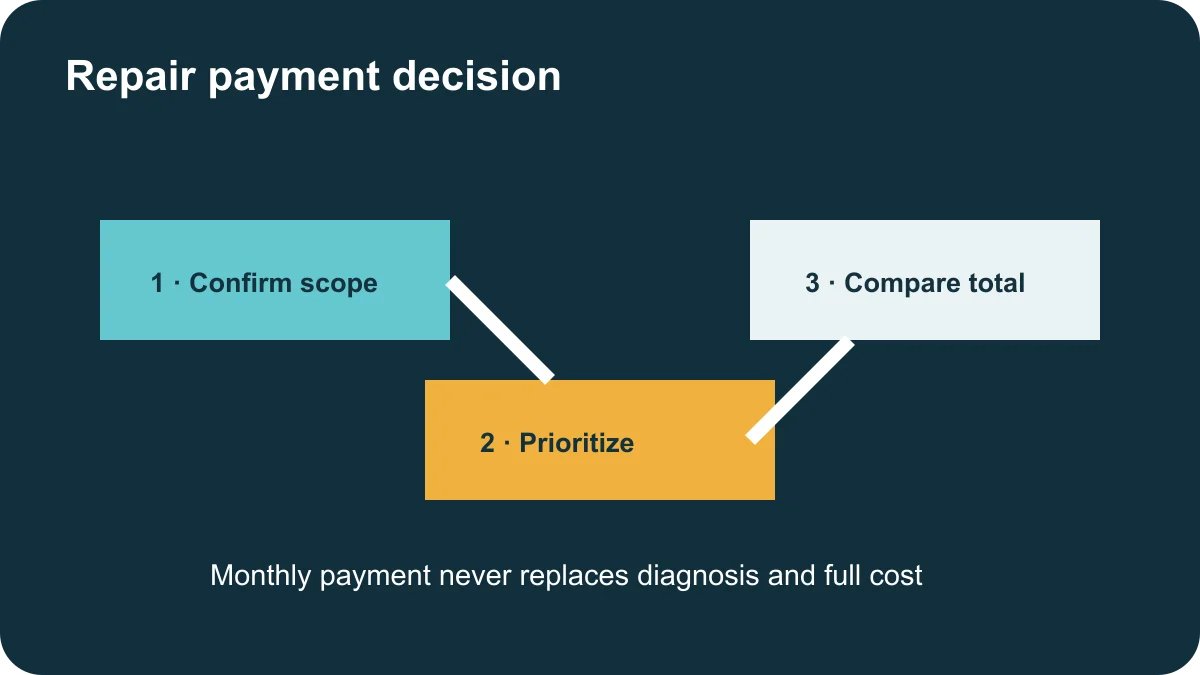
The immediate answer: there is no verified site financing offer
Auto Sport Imports does not currently publish a verified lender, credit application, interest rate, repayment term, approval criterion, discount, or financing partner on this site. Do not submit a Social Security number, bank login, payment-card details, or credit application through the general site mailbox.
This page restores a historically ranked URL without reviving an unsupported sales claim. Its purpose is to help a Washington driver define the repair, compare written terms, and decide what to ask if a repair provider or independent lender offers a payment plan. Availability and eligibility must be confirmed directly with the real provider.
Separate diagnosis from the final repair authorization
When the failure is uncertain, authorize a bounded diagnostic step before financing a large guessed repair. The result should identify the concern, evidence, recommended correction, alternatives, limitations, and verification. Ask whether the diagnostic charge applies to the repair and which new finding could change the estimate.
Washington Attorney General guidance emphasizes written estimates and authorization. A finance decision should use the same defined scope: parts, labor, taxes, fees, fluids, programming, towing, storage if applicable, warranty, and possible follow-up. A payment amount without the cash price and complete repair scope is not enough to compare.
Prioritize safety and damage prevention before convenience work
Ask the provider to classify findings: unsafe to drive; likely to cause major damage if delayed; required for reliable operation; scheduled maintenance; monitor with a measurable limit; or optional. The labels need evidence. A small leak, worn measurement, warning, or noise should include the consequence, current severity, and trigger for action.
Prioritization is not permission to ignore safety or conceal a larger problem. It can reveal whether work can be staged, whether related access makes combining jobs economical, and whether a second opinion is sensible. The editorial judgment is that borrowing should follow a defensible repair plan—not create pressure to accept every item on an inspection at once.
Compare total obligation, not the monthly payment
If financing is offered, request the cash price, amount financed, annual percentage rate, finance charge, payment count and amount, total of payments, late terms, prepayment rules, collateral or lien terms, required add-ons, and refund treatment if the repair changes. Read the actual agreement and verify the lender identity before providing sensitive information.
A short repayment period may have a higher payment but lower finance cost; a longer period can lower the payment while raising the total. A promotional period may change to another rate or accrue deferred interest under its terms. These are general comparison questions, not a prediction of any product. For personal financial advice or contract interpretation, use an appropriately qualified adviser.
Check warranties, service contracts, insurance, and assistance separately
Before borrowing, check whether a manufacturer warranty, parts warranty, service contract, recall, collision coverage, roadside benefit, or other documented program applies. The FTC notes that an auto service contract is different from a warranty and that coverage, exclusions, deductibles, claim approval, and authorized facilities vary.
Do not assume a program will reimburse work after it begins. Obtain required diagnosis, authorization, photographs, maintenance records, prior approval, and facility eligibility first. Also verify whether you must pay and seek reimbursement, whether teardown is covered, and who pays when a claim is denied. Never represent a pending claim as guaranteed payment to the repair provider.
Worked scenario: a large cooling-system estimate
A driver receives an estimate for a water pump, thermostat, coolant, related hardware, and labor after an overheat. Before choosing a payment plan, the driver asks what confirmed the pump, whether internal engine damage was assessed, which items share access, what can safely be separated, and how filling, bleeding, temperature stability, and leakage will be verified.
If testing supports the full scope, the driver compares the cash total and any finance terms. If the estimate assumes rather than proves the cause, financing the entire job increases the risk of paying interest on an incomplete repair. The example shows why the repair decision and payment decision are linked but should not be collapsed into one sales step.
Preserve records and protect sensitive information
Keep the diagnostic report, written estimate, authorization changes, finance agreement, receipts, invoice, parts description, warranty, and payment history together. Confirm that the final invoice matches authorized changes and that unused or removed parts are handled as agreed. If the repair scope decreases, ask how the financed amount or refund will be adjusted.
Use only the lender or provider’s verified secure channel for sensitive applications. Check the domain and contact details independently, and do not send credentials or identity documents to server@autosportnw.com. For site-content corrections or questions about this guide, use that mailbox without including financial account information.