
Parts decision guide
Choose a repair part by identity, evidence, warranty, and total scope—not a label alone
“OEM” is often used loosely. A useful parts decision identifies who made and sold the part, whether it matches the exact vehicle, which updates or included hardware apply, who stands behind it, and how labor and programming affect the complete repair.
The immediate answer: ask for the exact part identity
Before approving a part, ask for the manufacturer, brand, part number or supersession, condition, included hardware, warranty provider, labor coverage, return restrictions, and why it fits the VIN and installed equipment. “Genuine,” “OEM,” “OE,” “OE supplier,” and “aftermarket” are not interchangeable promises, and sellers may use them inconsistently.
This page does not claim that Auto Sport Imports currently sells parts, holds inventory, or has a manufacturer purchasing program. It restores a ranked historical URL as an independent decision guide so the parts keyword has a complete, honest destination.
Separate genuine, OE-supplier, and aftermarket channels
A genuine part is normally sold in the vehicle manufacturer’s branded channel. An original-equipment supplier may manufacture a component used in production while also selling parts under its own brand, but a supplier-branded item is not automatically identical to every manufacturer-branded version. Design revisions, software, calibration, accessories, packaging, warranty, and included hardware can differ.
Aftermarket covers a wide range: a specialist may improve a known weakness, a reputable manufacturer may meet a defined specification, and a low-information listing may provide little traceability. Country of origin, appearance, or a claim that a part “fits” does not establish material, calibration, durability, emissions legality, or exact compatibility. Evaluate the specific part and application rather than ranking categories by slogan.
Remanufactured, rebuilt, and used parts answer different needs
A remanufactured assembly is generally returned to a defined production process with inspection and replacement criteria, while “rebuilt” can describe a narrower repair whose scope depends on the rebuilder. A used part preserves its prior wear and history. None of these labels alone explains what was measured, renewed, programmed, cleaned, or warranted.
These choices can be reasonable when a new assembly is unavailable or uneconomic, but the estimate should address core charges, shipping, contamination, coding, immobilizer or component-protection limits, mileage or donor identity, and what happens if the unit cannot be adapted. A cheaper assembly can become the expensive option when duplicated labor and programming are excluded.
Fitment requires more than year, make, and model
European vehicles may vary by VIN break, engine code, transmission, brake package, suspension, emissions family, build date, market, software level, connector, sensor strategy, and installed options. Match the exact catalog and service information, then compare the removed part and any supersession instructions. Visual similarity is not proof of interchangeability.
Fluids, filters, batteries, sensors, modules, pumps, catalysts, lighting, and safety components can have specifications beyond dimensions. Ask whether the part requires coding, adaptation, initialization, calibration, firmware, a matched set, one-time hardware, sealants, or a prescribed break-in and verification procedure.
Warranty questions belong in the estimate
The FTC explains that routine service outside a dealer does not automatically cancel a vehicle warranty and that aftermarket or recycled parts do not automatically void coverage. However, damage caused by a defective part or incorrect installation can create a coverage dispute. Review the actual vehicle warranty or service contract rather than relying on a universal statement.
Ask separately about the vehicle warranty, the part maker’s warranty, the seller’s return policy, and the installer’s labor warranty. Record who handles a claim, whether diagnostic and removal labor is covered, whether another failed system is excluded, and what maintenance or documentation is required. Spoken assurances should be written into the repair record when they matter to the decision.
Worked comparison: an electronic water pump
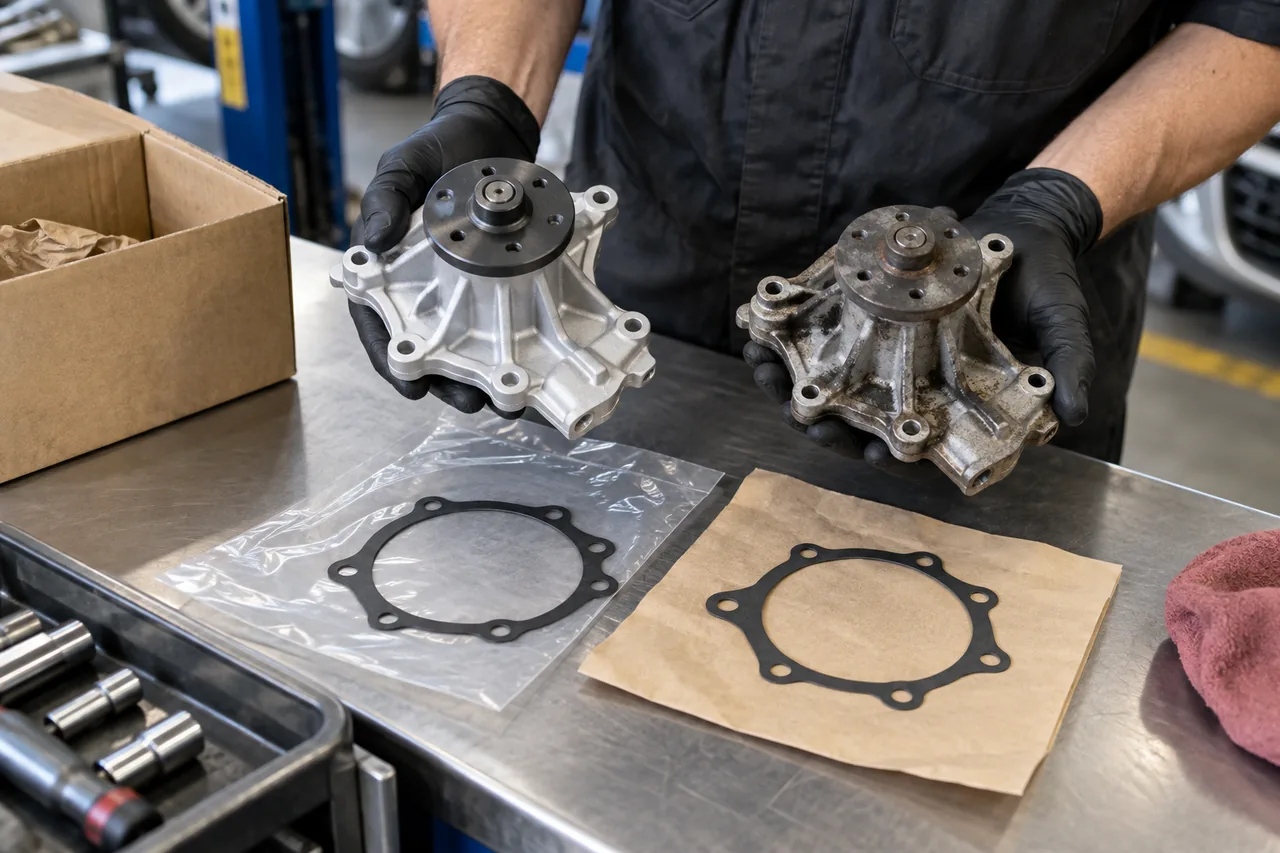
Consider three quotes for an electric water pump: a manufacturer-branded assembly, a supplier-branded assembly with the same apparent housing, and a low-cost unverified listing. The price comparison is incomplete until each quote identifies the exact supersession, thermostat or connector scope, seals and bolts, coolant, filling and bleeding, control tests, warranty, and post-repair verification.
If diagnosis has not established failed command, power, ground, communication, mechanical operation, leakage, or circulation, even the highest-quality pump may not fix the vehicle. The editorial judgment is to fund diagnosis and complete scope first, then choose the part channel whose identity, support, and risk match the vehicle and expected ownership period.
Use the invoice as the permanent parts record
Washington consumer guidance says the invoice should describe services and parts and indicate rebuilt, used, or applicable aftermarket body-part status. For a useful maintenance history, retain the brand, part number, condition, quantity, fluid specification, programming or calibration performed, measurements, and warranty terms even when the minimum invoice rule does not require every technical detail.
After repair, verify the original symptom, check for leaks or warnings, confirm required adaptations and readiness, and keep the removed part when requested before work and when return rules permit. A label is not the outcome; a correct, documented, verified repair is.