Engine-mechanical diagnosis
Prove the mechanical failure and its cause before choosing an engine repair
Noise, oil consumption, smoke, low compression, overheating, misfire, metal debris, or a timing-related code can point toward internal engine work, but each can also be produced or worsened by external systems. A responsible plan establishes the failure, cause, damage extent, repair options, and verification method before major disassembly.
Stop operation when continued running can multiply damage
Shut the engine down safely for a red oil-pressure warning, severe overheating, sudden heavy knock, smoke accompanied by loss of oil or coolant, rapid fluid loss, runaway speed, a major timing noise, or a flashing engine warning with severe shaking. Do not repeatedly restart an engine to identify the sound. Loss of lubrication, coolant, or correct timing can convert a limited fault into damage across bearings, cylinder heads, pistons, valves, catalysts, or turbochargers.
Record the exact warning, gauge behavior, sound, odor, smoke color, road condition, engine temperature, and events immediately before it began. Check fluid levels only using the safe procedure and do not open a hot pressurized cooling system. Arrange transport when normal lubrication, cooling, timing, or combustion cannot be confirmed.
Define the concern and preserve electronic evidence
Separate slow cranking from cranking without starting; a single-cylinder misfire from a whole-engine loss of power; startup rattle from a continuous knock; external leakage from consumption; and blue, white, or black exhaust under defined conditions. Note cold or hot operation, load, engine speed, duration, fuel level, recent maintenance, previous overheating, and whether oil or coolant was added.
Scan every relevant module before disconnecting the battery or clearing codes. Save confirmed, pending, and permanent faults, freeze-frame data, misfire counts, fuel correction, temperature, load, oil-related data where available, and the sequence of warnings. EPA describes OBD as monitoring emissions-related systems and alerting to detected malfunctions; its output is evidence about monitored behavior, not automatic proof of an internal part failure.
Rule out external systems before internal disassembly
Air leaks, restricted intake or exhaust, ignition faults, injector or fuel-pressure problems, sensor bias, wiring, low system voltage, contaminated fuel, accessory-drive noise, exhaust contact, turbo plumbing, and software or adaptation issues can overlap with an engine complaint. Inspect recent work and establish that the engine has the correct fuel, air, spark or injection command, and electrical supply before interpreting mechanical tests.
Fluid on the engine exterior may travel from a higher seal or housing, while oil in an intake or exhaust path may have more than one source. Clean and trace fresh leakage where appropriate. A symptom changing when a connector is unplugged or a code is cleared does not prove that component was the cause; it may only show that the control strategy changed.
Compression and leak-down answer different questions
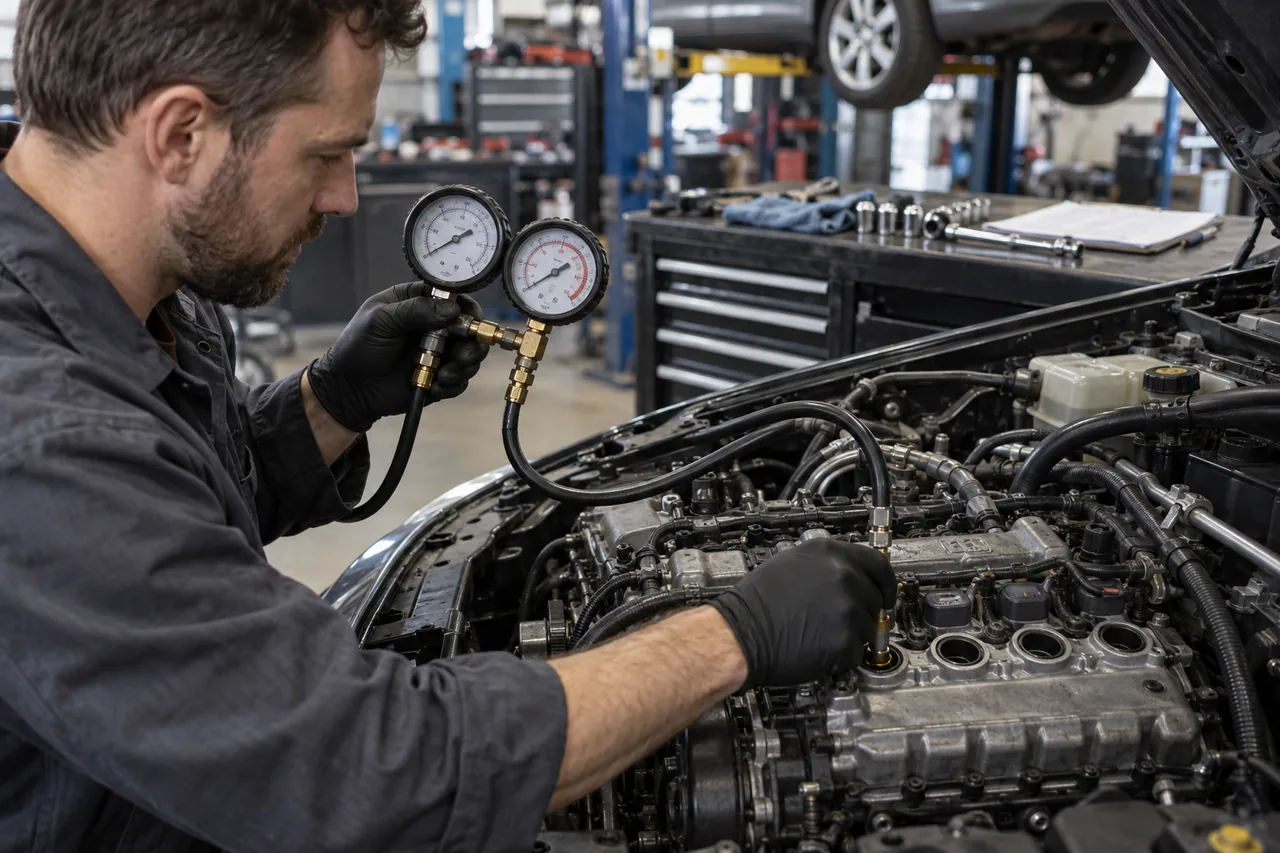
A compression test compares the pressure produced during cranking under controlled conditions. Battery speed, throttle or air path, fuel disablement, temperature, gauge method, engine design, and test sequence influence the result. Compare the readings with the correct procedure and with each other rather than relying on a universal number copied from a different engine.
A cylinder leak-down test introduces controlled air with the piston positioned as specified and can help localize leakage toward intake valves, exhaust valves, crankcase, adjacent cylinders, or cooling passages. It does not by itself grade every cylinder-wall, ring, head-gasket, or valve condition. Combine it with borescope findings, running data, oil and coolant evidence, and any required wet comparison or dynamic test.
Oil pressure, oil condition, and noise must be connected
An oil-pressure lamp or scan value should be verified using the engine-specific procedure and, when appropriate, a known accurate mechanical gauge at the specified oil temperature and engine speed. Oil level, correct specification, filter, dilution, aeration, pickup restriction, pump or control function, bearing clearance, leaks, and sensor circuits can affect the observed result. Adding thicker oil is not a diagnosis or repair.
Identify when a noise occurs and whether it follows crankshaft speed, camshaft speed, load, temperature, oil pressure, cylinder contribution, or an accessory. Inspect the filter or drained oil for debris only with a clean documented method. Metal location and type can inform the scope, but visible particles do not alone identify every damaged part. If lubrication failure is supported, find the cause and contamination path before installing replacement components.
Timing and valve-train faults require exact reference procedures
Correlation codes, poor compression, startup rattle, misfire, or abnormal cam response can involve a chain or belt, tensioner, guides, sprockets, actuators, oil-control valves, sensors, trigger wheels, worn valve-train parts, incorrect prior assembly, or base oil-pressure problems. Verify signals and commanded versus actual behavior where useful, then establish mechanical timing with the specified tools and references.
Paint marks and generic videos are not substitutes for engine-specific locking positions, rotation direction, tensioning sequence, torque and angle values, or interference precautions. A shifted timing system may have bent valves or piston contact even after alignment is restored. Define how related damage will be checked and which one-time-use fasteners, seals, fluids, and adaptations are required.
Overheating and coolant loss need a damage assessment
An overheat can begin with an external leak, trapped air, thermostat, fan, radiator, drive, water pump, electric control, incorrect fill, or combustion leakage. Confirm the initiating fault rather than assuming the cylinder-head gasket caused every temperature event. Pressure testing, temperature comparison, circulation checks, combustion-gas evaluation, leak-down, plug or cylinder inspection, and cooling-system behavior may be combined according to the evidence.
If internal sealing damage is supported, assess cylinder-head and block condition, surface finish and distortion requirements, thread integrity, contamination, bearings, catalysts, hoses, and cooling components affected by heat or mixed fluids. Replacing a gasket without correcting the original overheat or confirming compatible surface condition can repeat the failure.
Choose among targeted repair, rebuild, and replacement with the same scope
A targeted repair may address a verified sealing, timing, valve-train, oil-control, or cylinder-head fault when the remaining engine condition supports it. A partial or complete rebuild adds measurement, machining, internal parts, cleanliness, assembly, and break-in requirements. A used, remanufactured, or new assembly has different included parts, history, warranty, core, shipping, installation, programming, and accessory assumptions.
Compare options only after listing what each includes: diagnosis, removal and installation, long block or short block content, cylinder heads, turbo or supercharger, intake and exhaust transfer parts, cooling and lubrication corrections, mounts, hoses, sensors, fluids, one-time-use hardware, coding, taxes, core return, warranty labor, and the response if the original external cause recurs. The cheapest headline number may omit the operations needed for a durable result.
Control cleanliness, measurements, and change authorization
Internal work needs a documented disassembly plan, clean storage, labeled parts, calibrated measuring and torque equipment, service limits, surface-preparation rules, fastener procedures, and contamination control. Before teardown, agree which discoveries can change the estimate and when photographs, measurements, machine-shop findings, or additional authorization will be provided.
An engine opened without a decision path can leave the owner committed before damage extent is known. The estimate should state the current evidence, the initial authorized stage, expected reusable and replacement items, possible findings, stopping point, reassembly obligations, and ownership of removed parts or cores. Current availability, technician capability, machining access, and warranty must be verified with the actual provider.
Verification must recreate the original condition safely
Before initial start, confirm fluids, priming or oil-pressure procedure, timing and free rotation where required, electrical and hose connections, cooling-system fill and bleed, fuel safety, fastener completion, and removal of locks or tools. Monitor oil pressure, temperature, leaks, abnormal noise, misfire, smoke, and relevant scan data from first operation rather than immediately raising engine speed.
After warm-up and a heat cycle, recheck levels and leakage, confirm cooling and charging behavior, complete adaptations or readiness steps, and repeat the original cold, hot, idle, cruise, or load condition safely. Document compression, leak-down, pressure, timing, scan, or emissions evidence that applies. A successful repair explains the original failure, corrects its cause and contamination consequences, and demonstrates that the engine operates normally without new warnings or leakage.