
Ignition service and diagnosis
Replace spark plugs by the correct schedule—and diagnose misfires as a complete combustion problem
Spark plugs are scheduled wear items on many gasoline engines, but a misfire can also involve ignition coils, wiring, voltage, fuel delivery, air distribution, compression, valve timing, oil or coolant contamination, and control strategy. A plug or coil named in a code is a starting point for testing, not automatic authorization.
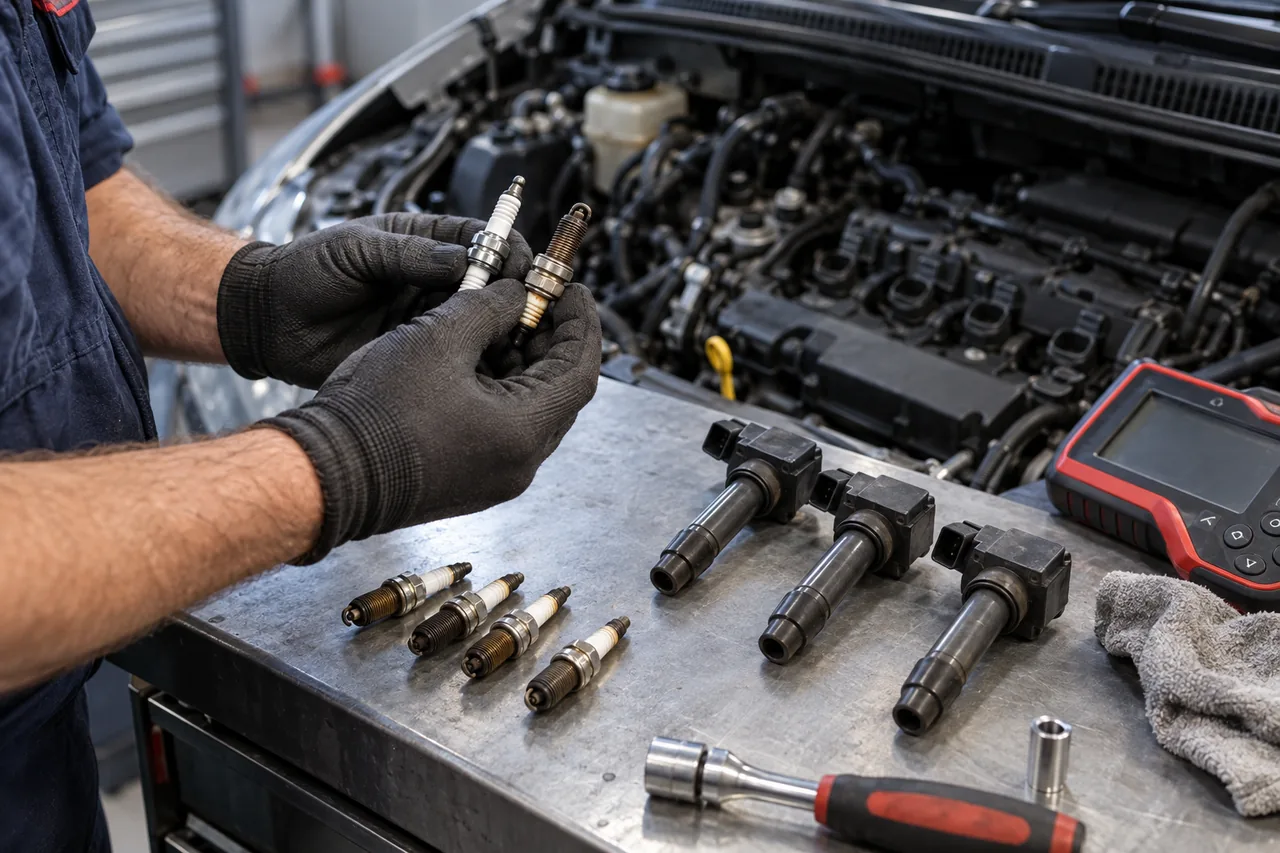
Treat a flashing engine warning and severe misfire as urgent
A flashing engine warning with shaking, loss of power, raw-fuel odor, smoke, or abnormal mechanical noise can indicate a catalyst-damaging misfire or another serious condition. Reduce risk by stopping safely rather than driving until the light becomes steady. Continued unburned fuel can overheat the catalyst, and severe mechanical faults can worsen with operation.
Record the warning, cold or hot state, engine speed and load, weather, fuel level, recent refueling or service, and whether the concern occurs at idle, acceleration, cruise, or startup. Do not clear codes or repeatedly swap parts before preserving freeze frame and cylinder-specific information.
Select plugs by exact application and interval
Confirm VIN, model year, engine code, induction type, emissions configuration, and manufacturer schedule. Thread diameter and reach, seat type, heat range, resistor design, electrode material and projection, factory gap, and service interval can differ across engines that share a vehicle name. A plug that threads into the head is not necessarily correct.
Use the vehicle specification and a trustworthy catalog, then document part number and interval. Do not substitute a hotter or colder range to hide deposits or performance problems unless the engine procedure specifically calls for it. Aftermarket tuning or modified boost can change requirements, but such changes need an engineering basis rather than guesswork.
A misfire code identifies a cylinder or condition, not the failed part
Review confirmed, pending, and permanent codes, freeze frame, misfire counters, fuel correction, load, temperature, voltage, and related air, fuel, timing, and emissions faults. A cylinder-specific code may be caused by the plug, coil, connector, injector, compression, valve train, intake leak, coolant or oil entry, wiring, or control. A random code can reflect conditions shared across cylinders.
Component swapping can be a controlled comparison when safe and supported, but moving a contaminated plug or failing coil can alter evidence or damage another position. Record original locations, inspect connectors and wells, and compare results under the same operating condition. The test should distinguish competing causes rather than merely move the code.
Removed plugs preserve useful cylinder evidence
Keep plugs in cylinder order and inspect thread, shell, seat, insulator, electrodes, gap, deposits, cracks, tracking, heat damage, and signs of oil, fuel, coolant, or foreign material. Bosch diagnostic guidance connects carbon fouling, oil fouling, ash, wear, melting, and cracking with different mixture, oil-control, thermal, maintenance, or handling causes.
Appearance is evidence, not a complete diagnosis. Modern fuel, additives, driving pattern, plug design, and recent operation affect deposits. A wet plug may result from a cylinder that never fired rather than an injector alone. Correct the air, fuel, oil, cooling, mechanical, or electrical root cause before installing new plugs into the same damaging condition.
Test coil power, ground, control, and insulation appropriately
Inspect coil boots, springs, terminals, seals, wells, grounds, harness strain, moisture, oil, carbon tracking, and heat damage. Verify supply and ground under relevant load and control signal using the correct diagram and equipment. Secondary ignition carries high voltage; improvised spark tests can injure, damage modules, ignite vapor, or create misleading results.
A coil may fail only hot or under cylinder pressure and load. Current ramps, scope patterns, controlled substitution, or known-good comparisons may support diagnosis when used correctly. Replacing every coil as routine maintenance is different from replacing a verified failed coil; the estimate should state why each part is included.
Fuel, air, and mechanical condition can defeat a healthy spark
An injector fault, fuel pressure, contaminated fuel, intake leak, carbon, airflow imbalance, exhaust restriction, low compression, leak-down, valve timing, worn valve train, head-gasket leakage, or cooling intrusion can create the same cylinder symptom. Compare injector command and contribution, fuel correction, compression or leak-down, and timing evidence as the fault pattern requires.
New plugs may temporarily fire through deposits or a widened old gap more effectively, but recurrence can reveal that the initiating cause remains. Do not use plug replacement as proof that an oil-consumption, fuel, or mechanical problem is repaired. Define whether the job is scheduled service, a supported ignition repair, or an initial step with documented follow-up.
Gap handling and installation can damage modern plugs or heads
Check the application-specific gap and whether adjustment is permitted. DENSO warns that careless regapping can damage fine-wire electrodes and porcelain, while Bosch identifies unnecessary gap adjustment as a common mistake. Never strike the center electrode or use a tool that loads the insulator. Protect plugs from drops and contamination.
Work on a suitable engine temperature, clean debris from wells without forcing it into the cylinder, start threads by hand, and use the specified dry or prepared-thread condition and torque procedure. Bosch advises against greasing threads and emphasizes type-specific torque. Over-tightening can distort the plug or damage an aluminum head; under-tightening can affect sealing and heat transfer.
Access work and related parts must be explicit
Some engines require removal of intake components, covers, braces, charge plumbing, wiring carriers, or seals to reach the plugs. Define gaskets, one-time-use hardware, cleaning, ignition boots, and inspection of accessible leaks. Shared access can make related work efficient, but every added coil or component still needs a maintenance or condition reason.
If a plug is seized, broken, cross-threaded, or contaminated by a damaged well or tube seal, stop and explain the extraction or repair risk before escalating. Thread repair, broken-shell removal, debris control, borescope inspection, and cylinder-head removal are materially different scopes from routine plug replacement.
Verify the original cold, hot, idle, and load condition
After installation, confirm connectors, hose and harness routing, intake sealing, fasteners, warning status, and smooth startup. Recheck misfire counts, fuel correction, coil or cylinder data, and any disturbed air path. A smooth idle alone does not verify a fault that occurred only under boost, highway load, rain, or hot restart.
Repeat the original condition safely, complete required readiness or drive-cycle checks, and inspect for new leaks or noises. Record plug part number, gap policy, torque procedure, replaced coils or seals, codes and pre/post data, and remaining uncertainty. If a misfire returns, preserve the new evidence rather than clearing it and repeating the same parts.