
Steering-assist diagnosis
Identify hydraulic, electro-hydraulic, or electric assist before choosing a fluid or pump repair
Heavy, inconsistent, noisy, pulling, or warning-affected steering can involve tires, alignment, suspension, mechanical binding, hydraulic fluid and pressure, an engine-driven or electric pump, electrical supply, sensors, software, the steering gear, or calibration. Many modern vehicles have no power-steering fluid at all.
Treat a sudden loss of assist or steering control as urgent
Stop safely for a sudden major increase in steering effort, binding, failure to return, unexpected steering input, fluid pouring onto hot or moving components, smoke, or a red steering warning. Reduced assist may leave a mechanical connection, but the force required can rise sharply and unpredictably. Do not continue simply because the wheels still turn.
Record the exact warning, vehicle speed, steering direction, temperature, weather, road surface, recent battery, tire, alignment, suspension, collision, or steering work, and whether restarting changed the condition. Check the owner’s manual response for the exact message and arrange recovery when safe control is uncertain.
Identify the system before checking fluid
Traditional hydraulic steering uses an engine-driven pump, reservoir, hoses, and a hydraulic steering gear. Electro-hydraulic steering uses an electric motor-pump with hydraulic actuation; ZF describes assist demand changing with steering angle and vehicle speed. Electromechanical EPS uses a motor at the column, pinion, or rack and normally has no hydraulic reservoir.
Do not add fluid to an unrelated reservoir or assume every steering warning means a bad pump. Record the VIN and exact steering equipment, then use the relevant service information. Rear-axle steering or lane-support functions can add modules, actuators, sensors, and calibrations beyond the familiar front steering gear.
Separate assist failure from mechanical resistance and road forces
Low tire pressure, mismatched or damaged tires, alignment, seized joints, strut bearings, ball joints, tie rods, steering-column joints, collision damage, wheel bearings, or rack binding can make steering heavy or prevent return even when the assist unit is operating. Inspect mechanical movement and tire condition before directing every complaint toward hydraulic or electronic parts.
Pulling is not proof of a steering-gear fault. Road crown, tire conicity, braking drag, alignment, ride height, suspension damage, and load distribution can change direction. Define whether the vehicle pulls hands-off, requires unequal effort, has an off-center wheel, or produces a warning or torque overlay under particular conditions.
Hydraulic leakage must be traced to its first fresh source
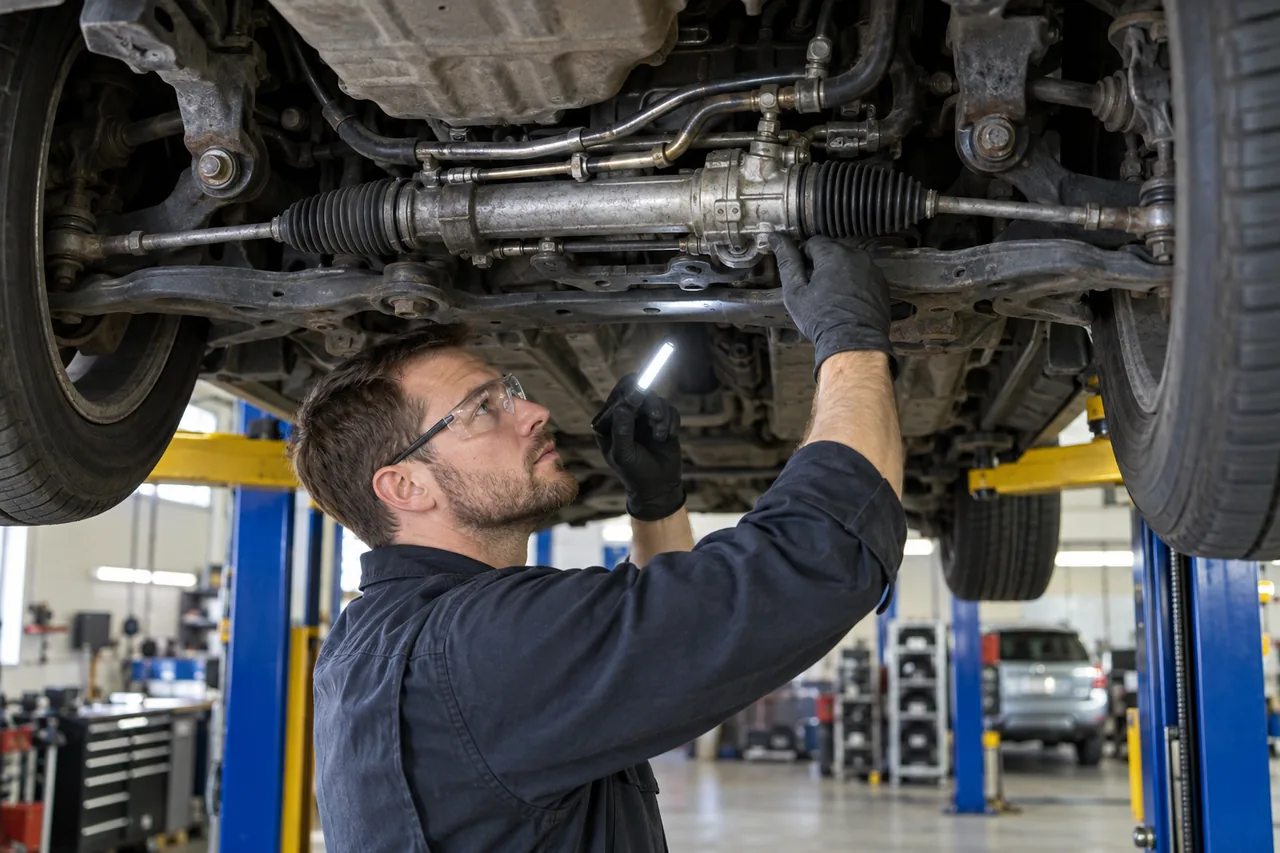
Inspect the reservoir, cap and seal, pump, shaft area, pressure and return hoses, crimps, cooler, clamps, connections, boots, and steering gear. Fluid can travel along hoses or undertrays before dripping. A wet rack boot may indicate an internal rack seal leak, while overfill, foaming, or an incorrect hose route can create a different pattern.
Confirm the exact approved fluid; color is not a specification and products are not universally interchangeable. Low level indicates loss or an incomplete prior fill, not normal consumption. Repair the leak, inspect fluid contamination and affected rubber or belt components, then fill and bleed using the model procedure instead of scheduling repeated top-offs.
Noise and foaming do not identify the pump by themselves
Whine can increase with low fluid, trapped air, restriction, incorrect fluid, hose vibration, low electrical voltage in an electro-hydraulic unit, mounting problems, or internal pump wear. ZF technical guidance emphasizes structured diagnosis and peripheral checks because premature motor-pump replacement is expensive and may not correct the noise.
Inspect temperature, level, aeration, contamination, reservoir screen where applicable, hose routing and supports, belt and pulley condition, electrical supply, and whether noise occurs only near full travel. Holding the steering against a stop can create maximum load and heat; do not use prolonged stop contact as a test. Measure pressure or current only with the correct procedure and limits.
Electric steering diagnosis includes power, data, and mechanics
Scan the steering, brake, body, powertrain, and network modules as applicable before clearing faults. Preserve freeze frame, voltage, steering angle, torque, motor current, temperature, assist command, vehicle speed, communication, and calibration status available for the system. Low voltage, charging faults, ground resistance, network loss, mismatched tire information, or another chassis module can affect assist.
A code naming a torque sensor, motor, module, or steering gear defines the detected circuit or performance condition. Test supply and ground under load, connectors and wiring, mechanical freedom, related data plausibility, and published software or service information before choosing a complete gear. Some components are serviced only as an assembly, but that parts policy is not diagnostic proof.
Define pump, gear, hose, or EPS replacement scope completely
For hydraulic or electro-hydraulic work, define the failed component, fluid, reservoir or filter provisions, hoses, seals, mounting hardware, belt or drive condition, contamination plan, bleeding, and leak verification. If a pump failed internally, determine whether debris requires additional cleaning or connected-component action before the replacement is exposed to the same system.
For electric steering, identify whether the column, motor, module, rack, wiring, or another chassis input is included; whether software, coding, characteristic mapping, component protection, steering-angle calibration, alignment, or driver-assistance calibration is required; and what warranty applies. ZF notes that electronics knowledge and software actions can be essential when modern steering systems are replaced.
Fluid service needs an actual reason and compatible method
A steering-fluid exchange may be supported by the manufacturer schedule, incorrect or contaminated fluid, component replacement, opened lines, or a documented condition. It cannot repair a leaking seal, worn pump, damaged gear, restricted hose, mechanical bind, or electric-assist fault. Ask what observation or requirement supports the service and which fluid approval will be used.
Avoid generic chemical flushing or mixing. The correct method may involve draining, disconnecting a return path, replacing a reservoir or filter, vacuum or manual bleeding, wheel-off-ground movement, scan-tool pump activation, or a defined engine-running sequence. Prevent the pump from running dry and contain fluid safely. The invoice should identify product, amount, procedure, and related repair.
Alignment and calibration complete many steering repairs
Steering-gear, tie-rod, column, suspension, subframe, wheel, or sensor work can change toe, steering-wheel center, steering-angle reference, end stops, assist maps, stability-control inputs, or driver-assistance operation. The required completion steps depend on the exact vehicle and repair; a centered-looking wheel does not prove that electronic references and alignment agree.
Before returning the vehicle, confirm secure hardware and line routing, correct fluid level without foaming or leaks where applicable, normal warning status, consistent assist in both directions, free return, no binding or abnormal noise, centered wheel, alignment and calibrations, and behavior at parking and road speed. Repeat the original condition and document any follow-up after a heat cycle.