
2026 U.S. repair cost detail
Initial diagnostic evaluation: price, process, and questions
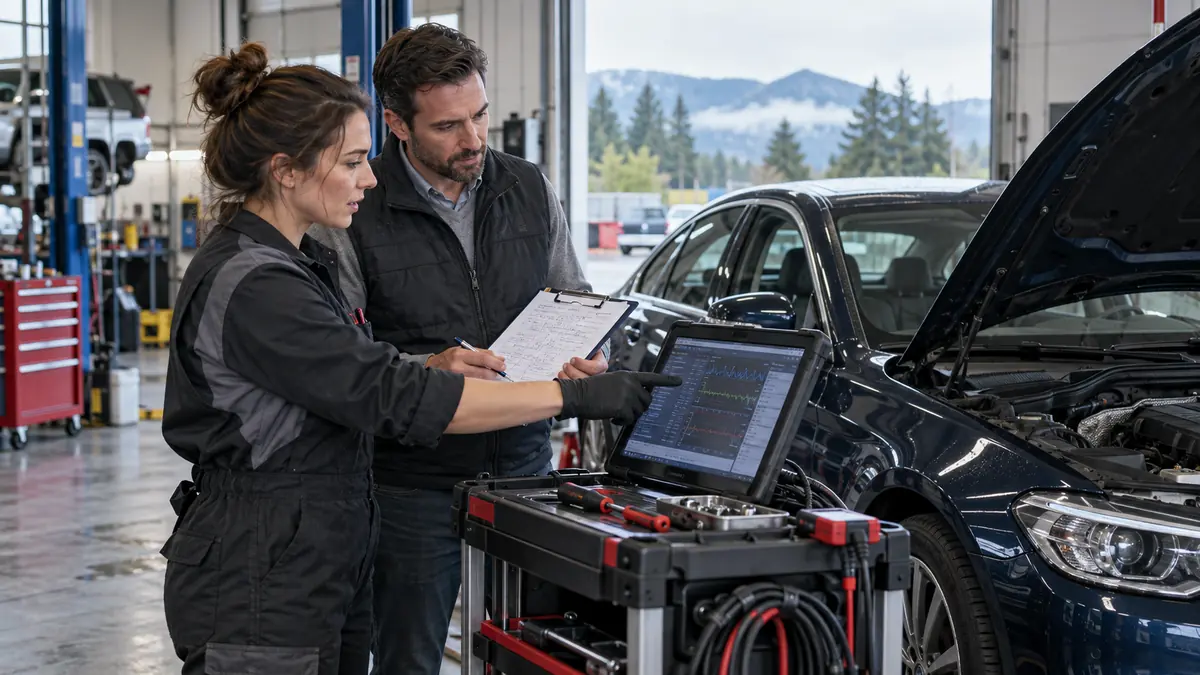
A useful diagnostic charge buys a defined investigation—not a promise that the first hour will identify every intermittent fault. The estimate should state the initial time or test scope and how additional testing will be authorized.
Choose the next step
Check the assumptions behind this estimate
Compare other repairs, confirm the evidence, account for the vehicle, and prepare the right questions before authorization.
Cost anatomy
What the price can be made of
A useful estimate separates the major scope instead of presenting one unexplained total. Not every line below applies to every vehicle.
Interview and confirmation
Recording when the concern occurs and reproducing it safely can take meaningful shop time.
System scan and evidence capture
A complete scan, freeze-frame information, service bulletins, and battery condition may be reviewed before circuit or mechanical tests.
Focused testing
Meters, pressure gauges, smoke equipment, scopes, or mechanical checks are selected from the evidence rather than applied as a generic package.
Findings and next-step plan
The useful deliverable is a documented conclusion, remaining uncertainty, and a repair or additional-test recommendation.
Repair method
A defensible service process
The exact factory procedure changes by VIN and equipment, but the estimate should still make these decision stages visible.
- 01
Record the exact concern, operating conditions, recent work, warning messages, and frequency.
- 02
Confirm the symptom when safe and preserve scan data before clearing codes.
- 03
Test the most supported circuit, system, or mechanical cause and compare results with specifications.
- 04
Document what is proven, what is ruled out, what remains uncertain, and what authorization is needed next.
Price variables
What can move the total
- An intermittent concern that cannot be reproduced
- Access that requires trim or component removal
- Multiple modules reporting a shared voltage or network fault
- Road testing, cold-soak testing, or overnight observation
Common questions
Questions drivers ask before authorization
Is a code scan the same as diagnosis?
No. A code identifies a monitored condition and helps choose tests; it does not prove which part failed.
Will the fee be credited toward repair?
Policies vary. Ask whether any portion is applied to authorized work and whether that changes the independence of the diagnosis.
Can diagnosis exceed the initial range?
Yes, especially for intermittent faults or systems requiring disassembly. Additional time should be explained and authorized.
What should I receive?
Ask for the concern tested, observations or measurements, conclusion, recommended scope, and unresolved limitations.
What if no fault is found?
A no-fault-found result can still be useful when it records conditions tested and defines the next evidence to collect.
Estimate checklist
Ask the shop to identify
- The exact vehicle, system, concern, and evidence supporting the work.
- Diagnostic labor, repair labor, parts, fluids, hardware, programming, calibration, disposal, tax, and excluded work.
- Which assumptions could require additional authorization after inspection or disassembly.
- The parts category and written parts-and-labor warranty.
- How the original symptom or maintenance result will be verified.
Method, limitations, and sources
The range is an editorial budgeting band for Greater Seattle and Puget Sound independent-shop planning in 2026. It reflects broad variation in imported and European vehicles and is deliberately wider than a single-shop advertised price. It is not a market average, offer, or substitute for a VIN-specific written estimate.
Continue by decision
Useful next steps for this topic
Choose the path that matches what you need to decide next. These links are selected from the same vehicle system, symptom, service, or regional context.
Follow the diagnostic evidence
A recharge restores a specified refrigerant mass; it does not explain why cooling was lost
Weak or intermittent air conditioning can involve refrigerant quantity or contamination, leakage, airflow, temperature and pressure sensing, fans, valves, compressor command or in…Follow the diagnostic evidence
Test the battery, starting circuit, charging control, connections, and vehicle loads as one system
A discharged battery, slow crank, warning lamp, repeated jump-start, low-voltage code, or charging complaint can involve battery condition and charge, terminal resistance, grounds…Understand the service scope
SeaTac auto A/C repair starts with airflow, temperature, and leak evidence
When cooling fades in SeaTac or Seattle traffic, the first task is to separate weak airflow from weak refrigeration and control faults. Refrigerant charge, leakage, compressor ope…Understand the service scope